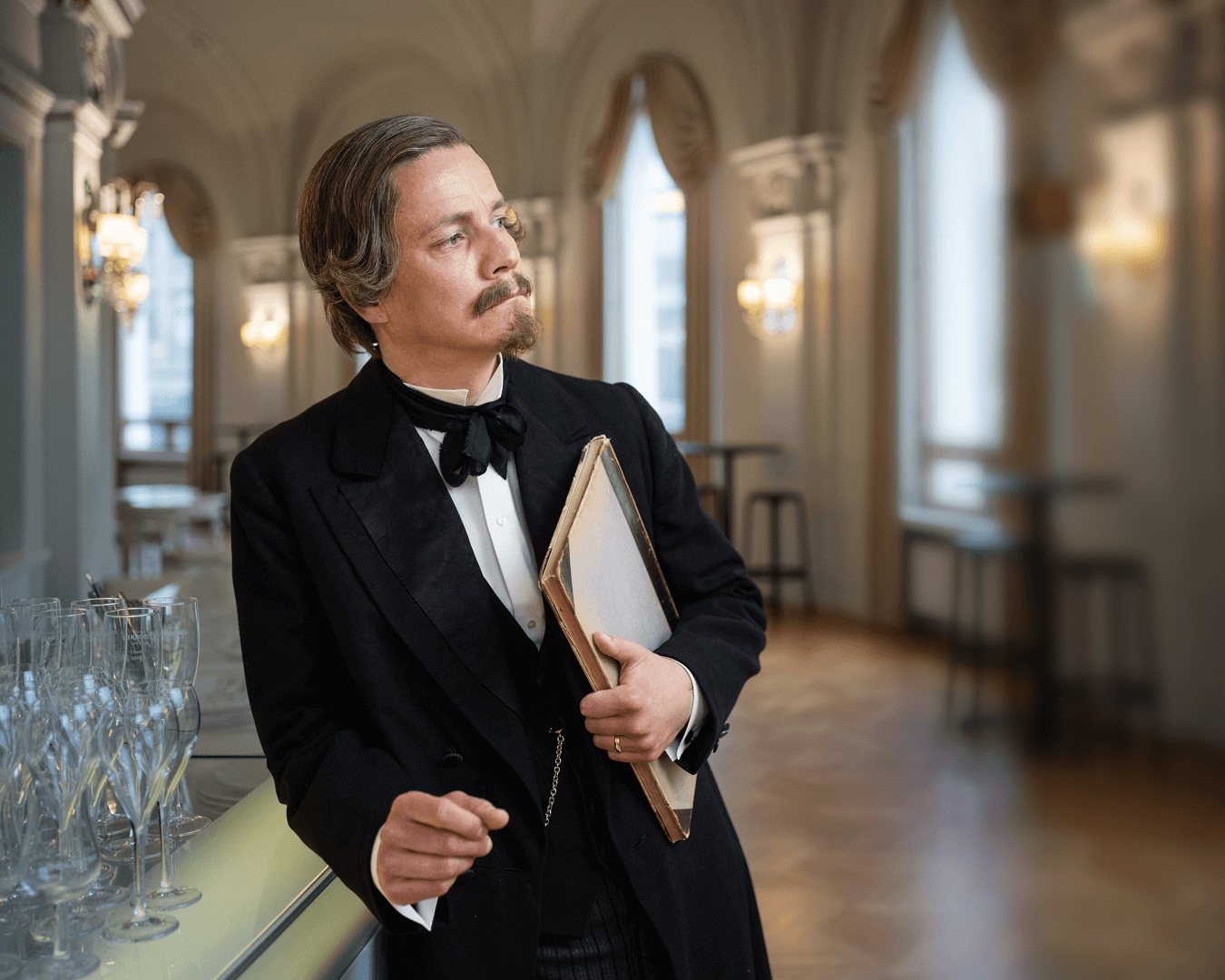
Topelius och teatern
Topelius och teatern
English summary
by: Iiris Autio
This text is a summary of the content of the walking tour. A new heading indicates a transition to the next space. It is characteristic of a guided tour that it adapts to the group at hand. At times, something mentioned in the summary may be left out, or Topelius may say something beyond it. You are welcome to ask him questions in English if something is unclear. You may also turn to the front-of-house host, who speaks English.
At the entrance
Welcome to the walking tour of the Svenska Teatern in Helsingfors*! On this tour we will see some of the spaces that are not visible during a regular visit. In addition, I will tell you how the Svenska Teatern has developed since the time when I myself was involved in founding it. A great deal has happened since then.
Photography is permitted during the tour, with the exception of ongoing set constructions and set designs, as well as other theatre staff should you happen to encounter them. You may photograph the front-of-house host and me.
Any questions?
Then let us begin. Please follow me.
In front of the elevator
We begin with the elevator, or the freight lift. Several elevators were installed in the building during the previous renovation in 2010–2012. In my time, people using mobility aids were not taken into account, but fortunately the building is now accessible.
In the elevator
This remarkably spacious elevator runs vertically through almost the entire building, which is very useful.
In earlier times, in a building this large one had to carry around an enormous bunch of keys. This electronic key is programmed to contain all keys, allowing access to different floors at the push of a button.
Out of the elevator
Please wipe your feet thoroughly on the mat, as no dirt or stones must be carried onto the next floor surfaces.
Backstage
Behind the main stage of the Svenska Teatern there is space for scenery and props. Productions alternate on the stage, and sets are easy to change by moving them through the large doors.
The backstage also serves as a passageway between the right and left sides of the building. During performances there is much activity here, as stage technicians use the small doors at the sides to access the stage and move large wheeled sets.
The props master is responsible for props—that is, the objects actors use during a performance—and sometimes even hands them directly to actors rushing onstage to make an entrée (entrance) or a sortie (exit), as theatre people traditionally say in French. For example, en face means acting facing the audience.
The auditorium is suitably empty if we wish to try an entrée on stage.
On the main stage
Welcome closer, straight into the heart of the Svenska Teatern—the main stage. I realize I have forgotten to introduce myself. I am Zacharias Topelius.
Born in Kuddnäs in Nykarleby, and having lived in Helsingfors and Sibbo. A writer, journalist, poet, former university rector and professor, and in this context most importantly, a former board member of this theatre and one of its founders. Thus, a suitable guide.
Let us begin at the beginning, when I moved here as a young man to study in the 1830s. Carl Ludvig Engel’s* small wooden theatre, also located on the Esplanade, was the only one of its kind. A white, tall building with wooden columns, a pediment roof, and elongated windows—it resembled somewhat the Church in the Old Church Park.
The brand-new, small, and charming theatre initially pleased my eyes, unaccustomed to the ways of a large city. But the years took their toll. The theatre building became outdated, and its wooden structure was not fire-safe. I and a few colleagues and friends at work and in the theatre wanted a new and modern stone theatre building for Helsingfors. The matter was written about in newspapers and discussed for some twenty years, until finally, in November 1860, Nya Theatern (New Theatre) was inaugurated on this site—a building that finally matched the dignity of Finnish theatre.
The modern building featured gas and water pipes as well as a beautifully decorated and heated auditorium seating 850 people. The imperial box was shining in the centre, but those of lesser means were also considered, with affordable seats in the third balcony. The large stage and its equipment were state-of-the-art.
Only two and a half years later, while ill with bronchitis, I awoke one night and saw a sky ablaze from the window of our apartment on Kyrkogatan*. The theatre was on fire. Only the outer walls remained.
Years of effort for the theatre—and for what? Before the fire, my daughter Rosa died while I was attending a financial meeting at the theatre, and during the time of Engel’s theatre my son Rafael died while my play An Adventure in the Archipelago was being rehearsed. After the fire, I no longer wished to sacrifice my life to the theatre and stepped down from the board to become an occasional visitor. And it seems I still am.
Though the building burned, the flames could not consume the fire of art. Soon after the fire, it was decided that a new building would be erected on the ruins, and it was inaugurated just three years later. This is the building you see today.
The name later changed from Nya Theatern to Svenska Teatern. In the construction of the new building, lessons had been learned from the previous one, and it was even better and more splendid. The auditorium still looks much the same.
Stage machinery has changed since my time. Previously, large backdrops were slid onto the stage through an opening in the ceiling from the paint loft above. Here they were hung on bars and operated manually using ropes. Stage workers communicated movements by whistling. You may have heard that one must not whistle in a theatre—otherwise a piece of scenery may fall on one’s head.
Today, stage technicians use headsets and microphones, and scenery is raised and lowered using computers. Acting styles have also changed. In earlier times, performances were emphatic and full of pathos. I found it occasionally somewhat artificial.
Today there are various styles, such as naturalism, which depicts reality more realistically and uses more everyday language, or abstract theatre, in which the audience creates meaning itself. There are musicals, dance, and film. Diversity is a good thing.
We will return here later by another route, but for now let us move on to talk a little about horses.
In the elevator
In my time, the theatre had a horse gate.
Well into the 20th century, horses were used to transport goods and people. Through this door, goods were once brought to the theatre by horse-drawn carts, which could be driven up a ramp onto the main stage. Today, automobiles stop outside the theatre, and goods are loaded into the elevator and transported to different floors. Though an automobile could fit in here as well.
Out of the elevator, in the basement
At times, real horses were seen on stage. Naturalism sought to replicate real life on stage very precisely: real food and drink, plants, and live animals. Rehearsals must have been bustling. No one probably ever stopped to ask what the horses thought about it.
At first glance, this basement looks fairly ordinary. During the previous renovation, the ground floor was expanded by 700 square meters, including new workshops and a sauna for the employees. After all, we are one of Finland’s national stages.
There was no costume storage in my time.
In the costume storage
Few have seen so many garments in one place. The theatre’s costume atelier, six floors above, sews everything imaginable, and we also have our own laundry and mangles.
How did one manage in the past, when actors had to pay for their own costumes? Rural clothing, historical costumes, the attire of the gentry and servants, and formal wear for various plays. Performances were impressive even then. There would be enough here to give to the poor, but of course it is good that actors no longer have to supply their own costumes.
Even so, this quantity is already too much. Moderation in all things. In my childhood, our housemaid Stina used to shout this from the kitchen to my father if I had messed something up.
In Stina’s opinion, Father should have been stricter with us. Our kind father did not beat us. The rod was mostly displayed as a warning. Only lying was considered serious enough to warrant punishment.
Sometimes, if I had misbehaved, my mother locked me in the pantry. The most important thing was to reflect on one’s actions and understand one’s mistakes.
Once, I was in the pantry in autumn—and ate all the freshly prepared jams and juices!
Let us move on.
To the elevator
Old bicycles had a larger wheel in front and a smaller one in back, and required a good deal of momentum or support to get going.
Workshop
Welcome to our own carpentry workshop. Here, stage sets are made of wood, and in the smithy or metal workshop sturdy base structures are added.
Previously, everything was sawn and forged by hand, but today mechanized and electric tools are used.
Paint shop
Here there is space for painting sets as well as a room for the props maker. They create props that cannot be bought ready-made. A production may, for example, require a vase that must break in exactly the same way into three pieces at every performance and then be reassembled for the next one.
Back into the elevator
Let us now leave the underground and the lowest level of the building. The elevator has seven floors, but we will exit on the sixth, so as not to end up in the seventh heaven.
Dining hall
Please have a seat. Some may remember the Miniscen stage, which was in this space before the most recent renovation. Now this is the staff dining hall, where intermission refreshments are also prepared.
In place of the Miniscen, another stage was built, and it has its own story. In the 1930s, an extensive renovation and expansion of the theatre building was carried out. This space and the large staircases on both sides of the building were constructed then, and the façade was changed to a functionalist style.
If you do not recall what the theatre looked like before that, we can move into the next room.
Stigzelius’s room
Here is the theatre before the 1930s renovation: yellow-brown, ornate columns, arched windows, and the caryatids—female figures supporting the entablature. Neo-Renaissance.
The renovation was already planned in 1916, but there were no funds. How, then, was there money twenty years later? On the wall you will find a clue.
Amos Anderson, one of the wealthiest and most influential men of his time, was also a patron of the arts and chairman of the Svenska Teatern’s board. Our friend Amos’s generous donation was a significant contribution to making the renovation possible. During the most recent renovation, the small stage on the left side of the building was named the AMOS stage in his honor.
But now I would like to take you to paradise and the gallery. With me you may go by stairs, and with the front-of-house host by elevator.
On the upper landing
Well now! Does this bust remind you of me? Beside it is my teacher Runeberg, with whom I also lived when I moved to Helsinki. His son Valter made these portraits.
In the corridor
Warning: if anyone has a fear of heights, it is best not to follow to the next place, but to remain in the corridor. We will keep the door open so that my voice carries.
On the third balcony
Welcome to paradise and the gallery! In the early days of the theatre, these were affordable seats for those of lesser means. Culture should not be only for the elite. At first, there were only places fro standing here, and when chairs were installed, one had to sit bent forward like a chimney pipe in order to see the stage. In addition, heat rising from gas lighting and the crowd made the space stuffy. Engel’s theatre had only candles and oil lamps, and all the soot rose upward—to the gallery. Today, the hall has air-conditioning units that keep the temperature comfortable.
Many do not guess what material the chandelier is made of! It is papier-mâché—paper pulp and paste—colored to resemble brass. In the old theatre that burned down, the chandelier was brass. Before the building’s inauguration, the mechanics for lowering the light for maintenance were tested—and bang! The chandelier fell onto the stalls. Fortunately, no one was injured, but it was decided to replace it with a lighter one, weighing only 50 kilograms. In my time, lighting ran on gas, later electricity, and today the chandelier uses energy-efficient and environmentally friendly LED lamps.
Floating on the ceiling, in addition to cherubs, are medallion portraits of well-known writers. Unfortunately, no female writers were included, although there were such writers. My parents were careful to ensure that my sister Sophie and I received the same upbringing and value regardless of gender. This was by no means self-evident at the time, and it greatly shaped me and my thinking. Therefore, I would like next to introduce a woman I admire, who was not only a skilled performer but also influenced the linguistic development of theatre.
With me you may go by stairs, and with the front-of-house host by elevator.
Portrait in the corridor
The actress and theatre teacher Hedvig Charlotta Raa-Winterhjelm was from Stockholm, but performed in Finland both in Engel’s wooden theatre and in this building. This powerful woman had a decisive impact on Finnish-language theatre.
At that time, theatre was not performed in Finnish, and Finland-Swedish came much later. Standard Swedish was considered the only language suitable for the stage. Nevertheless, there were advocates for domestic and Finnish-language theatre; in addition to myself, among them Kaarlo and Emilie Bergbom, who later founded the Finnish Theatre.
In 1869, the Bergboms decided that Aleksis Kivi’s new play Lea would premiere here at Nya Theatern—in Finnish. Four Finnish-speaking men played the male roles, but for the title role of Lea, the Bergboms wanted a genuine prima donna—that is, a certain skilled but Swedish actress who therefore did not speak Finnish: Hedvig Charlotta. She stubbornly memorized her lines, and although she may not always have understood what she was saying, she threw herself into the role with such enthusiasm that the work was a success.
Hedvig Charlotta was the first woman to speak Finnish lines on a professional stage. The premiere is considered the birth moment of Finnish theatre. It apparently required a Swedish woman!
Time is flying, and there is still one place left to see. With me you may go by stairs, and with the front-of-house host by elevator.
The theatre board’s box
Please come in, even though the box is no longer as large as it once was. There used to be a cabinet here where refreshments could be enjoyed. It was removed during the previous renovation to make space for the public elevator. A small space was lost, but accessibility for the entire building was gained. A very important change!
This box is reserved for the theatre’s board. Opposite is the imperial box, for which the court in St. Petersburg once paid 1,000 rubles per year in rent. Since Finnish independence, it has been the presidential box. Boxes symbolize power—and power can be a complicated matter.
In old and large buildings like this, one finds an interesting phenomenon: secret passages. Speaking of power, there was once a tall wall mirror in the imperial box’s cabinet, behind which was a hidden door. Presumably, it led to the corridors of the actors’ dressing rooms. One governor-general, who often sat in the box, installed the door to arrange intimate encounters with certain actresses. This was an inappropriate expression of hierarchy and power. Fortunately, the door was removed in 1936.
Both boxes contain original furniture. I have watched many performances from here—though in the previous theatre building. From here one can clearly see what happens behind the scenes. Later, when I visited the theatre as an ordinary audience member, I would sit in the small box above, so as not to attract too much attention. “Look, Topelius!” No, thank you!
We are soon finished. Do you have any questions? (You may also ask in English.)
Let us move on to conclude the tour in the direction of the cloakroom.
With me you may go by stairs, and with the front-of-house host by elevator.
Cloakroom
Dear friends, time has flown by, but I would like to say a few final words. I wish to thank you for taking part in this tour. I hope your experience has been pleasant and that we will meet again.
Allow me to say farewell with a stanza from one of my poems, which seems fitting for the occasion:
Here the surging waves fall silent
in morning dew, in evening peace.
Here only a dear memory drifts
of fleeting life, of passing time.
Linger, traveler, whoever you may be;
remain in peace, in goodness, in joy.aamun kasteessa, rauhassa illan.
Tääll´ häilyy vain armas muisto
ohikiitäneen elämän, ajan.
Viivähdä kulkija, ken lienet;
jää rauhaan, hyvään, onneen.
Warm thanks! Now I must return to where I came from.
Greetings to future generations!
*Helsinki
*Uusikaalepyy
*Sipoo
*Carl-Ludvig Engel was a famous architect