Milja Sarkola’s writing straddles the worlds of a diary’s intimacy and the theatre’s collective format. She aims for a conciseness whereby words do not exhaust emotions, but open up space for anxiety, longing and resistance. In Sarkola’s plays, the private is never purely confessional, but instead a device that tests the limits of what can fit on a stage. Her latest play, Forget Me, premiered on the AMOS stage on 3 December 2025.
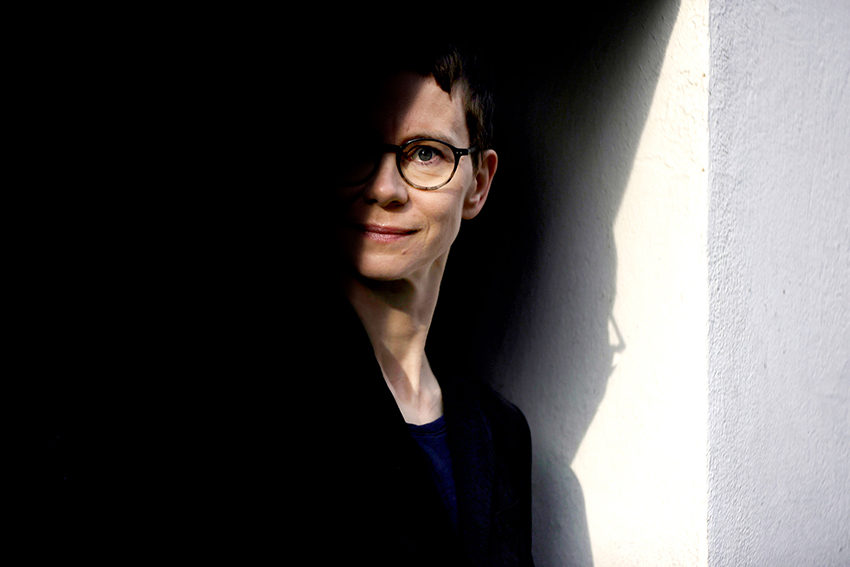
– I always feel most things to be excessive.
Conciseness of expression is something that playwright Milja Sarkola has wrangled with her whole life, from her diaries to her studies at the Theatre Academy. When she began to write prose, the greatest challenge lay in producing larger quantities of text, longer grammatical units; flow. In plays, the shifts are quicker. Carefully crafted scenes progress in sharp, lightning-like flashes.
– The form is right for me when I manage to capture the words without overwriting them: when an emotion is evoked without my writing it out.
Inspired by a yearning for plays of literary value
In her reading, Sarkola is attracted to all kinds of texts, even aggressively expressive ones. She is often confounded by deceptive simplicity – an artfully sterile surface, under which powerful currents run. During our meeting we discover a shared fascination for the texts of the writer Harry Salmenniemi. How can sentences be so simple yet so troubling and comical all at once?
– It is the lyricist in him. The same applies to the plays of Tuomas Timonen, or someone like Jon Fosse. That airy quality.
Sarkola reads a lot, generally more prose than plays. And twentieth century rather than the ancient world.
– It’s a little embarrassing, but I must confess I’m terribly modern. My education begins somewhere in the nineteenth century with Flaubert, Dostoyevsky and Chekhov. And Freud – what he did with literature. I somehow can’t escape him.
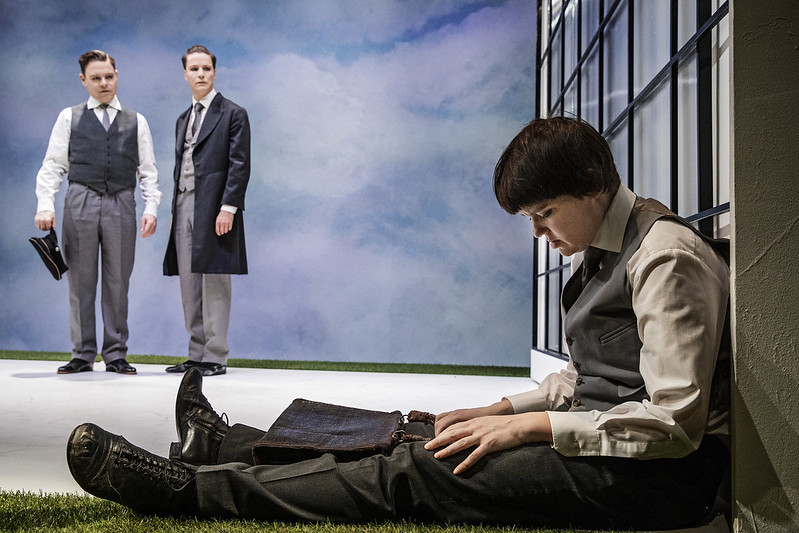
One of the things that inspired Sarkola’s writing was a longing for plays with a higher literary value. Her first work, Perheenjäsen (“Family Member”), was staged at Teatteri Takomo in 2011. In it, a daughter can only meet her father onstage, because the public sphere has replaced the private in their theatrical family. A mother, or girl, screams at her child that she cannot cope with being stuck at home: she needs to work. Perheenjäsen was pioneering in the Finnish dramatic landscape due to its autofictional form, which was crafted with a charged kind of exactitude.
“The experimental in the mainstream”
Before that, Sarkola had directed several pieces written by others, and worked with a dance orientation with choreographers from the Zodiak dance centre. She found herself growing weary of conceptual forms.
– I didn’t want the text to be improvised: I wanted it to have a higher standing.
Her idea of what constitutes theatre was moulded during her upbringing, via the offerings of Helsinki’s Lilla Teatern in the 1980s. With her father being a theatre manager, Sarkola became familiar with all the revues, tragedies, farces and classics performed there. They all shared a certain tone: a combination of directness and respect for the audience. Sarkola learned that a theatre would sink without its viewers – financially and otherwise.
– At the Theatre Academy, the relationship with the audience became much more remote. But I truly want to connect; that is where I feel that things happen.
She describes this ideal as “the experimental in the mainstream.” To reach outwards but, once there, to succeed in stretching meanings and creating something new. Those are the moments that for her feel most effective in the auditorium.
Sarkola writes her plays with herself in mind as director. Although the direction can evolve collectively, she guards her text closely. To a great extent, this is due to her plays springing from her own observations and autobiographical materials. A timid inner experience requires a sensitive touch.
– I seek an exactitude in subjectivity that is hard to create collectively. That is probably why I also write prose these days: that type of text can better earn the right to contain the self.
Ever fascinated by psychology
Is there anything that is too private to be performed on stage?
– I’d rather call it incomplete. Art will just not come out of it; it will lack form. If I write something about myself, I won’t think it is unusable, only that it isn’t ready yet.
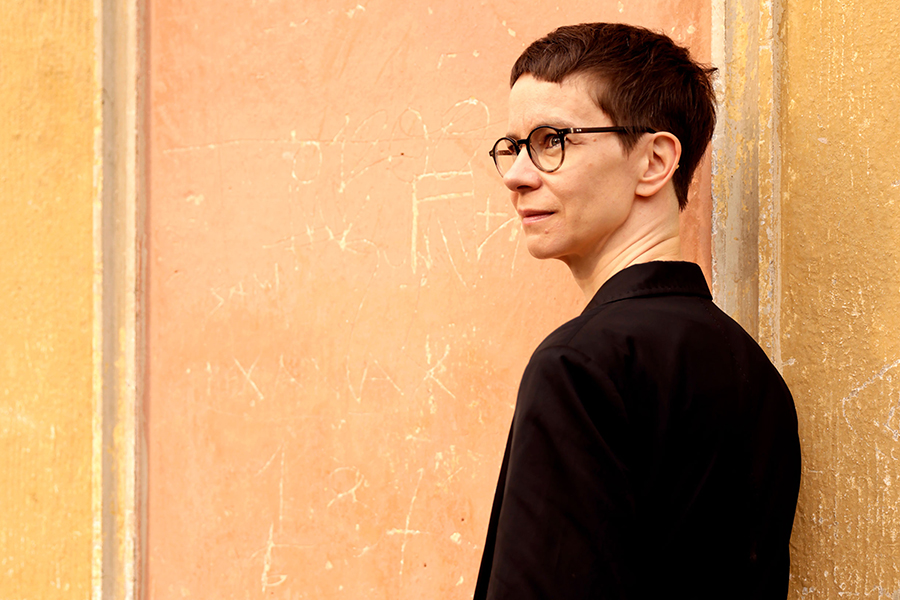
Sarkola has always been fascinated by psychology. The question of why people are the way they are has bothered her ever since childhood, and her selfhood has been characterised by deep unrest. She recalls a trip to Mongolia:
– We are there on the mountain, far from civilisation and everything that is familiar to me. Some sort of argument breaks out and I am suddenly floored by the insight that I am never going to escape myself. Here I am at the ends of the earth and I am still the same person with the same problems. It was just incredibly frustrating.
The realisation of not being at all the way one would like to be led to the play Jotain toista (“Something Else”), performed at Q-teatteri in 2015. Wishes and behaviours are hardened, while desire and intimacy are difficult to accommodate together. The fantasy of a stranger leaping out of the bushes is easier to relate to than one’s own partner and her sexuality; the latter comes with a whole world of responsibilities and annoyances.
Is life as a couple not meant for everyone?
I suggest that romantic relationships often force us to meet certain uglier truths about ourselves, whereas in the company of friends and acquaintances it’s easier to maintain a more ideal self-image.
– Absolutely. That’s why I also enjoy friendship so much.
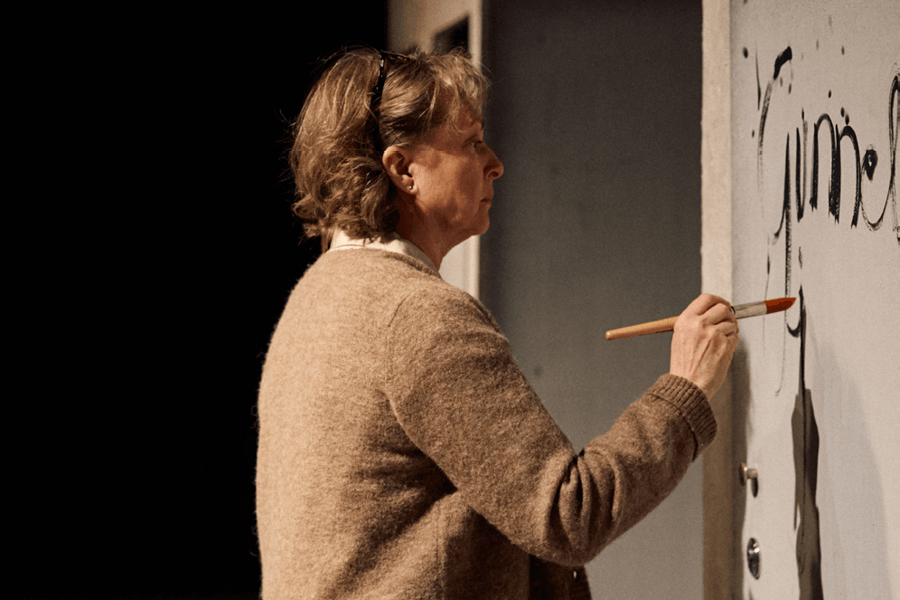
But if one chooses to live alone, is that done out of fear or because life as a couple is quite simply not meant for everyone? This was a question that Sarkola hoped to approach in her most recent play, Forget Me, which premiered at Svenska Teatern in December 2025. It is based on a person, known in the play pseudonymously as “Gunnel”, who lives without any intimate relationships and expresses a specific desire to be forgotten when she dies.
The real-life model for the character contacted Sarkola and suggested the topic for a play. They did not offer to collaborate in the project, but the process gradually developed in that direction. The documentary form was added later on. Sarkola emailed questions and “Gunnel” responded in writing, and the conversation is presented as a part of the performance. Even though quotations from the interviews are sometimes reproduced word for word, the dramaturgy and composition have the playwright’s characteristic stamp. On stage, the conversations are personified and anonymised by actor Anna Hultin.
The existence of the play makes evident – if unwittingly – the duality that can be found in a person like “Gunnel”. On the one hand there is the express desire to be forgotten; on the other, a shadow of the self that resists this impulse breaks through. Not everyone who is forgotten gets to have their life represented on a theatrical stage.
Excitement also grew within play’s subject during the process: they began to look forward to Sarkola’s questions in order to be forced to think about their life – perhaps for the first time ever.
– I took on the role of antagonist in the conversation. It happened quite naturally. After all, on the surface, ‘Gunnel’ has seemed to make completely the opposite choices from those in my own life: no children, no partner, no therapy, no close relationship with their childhood family.
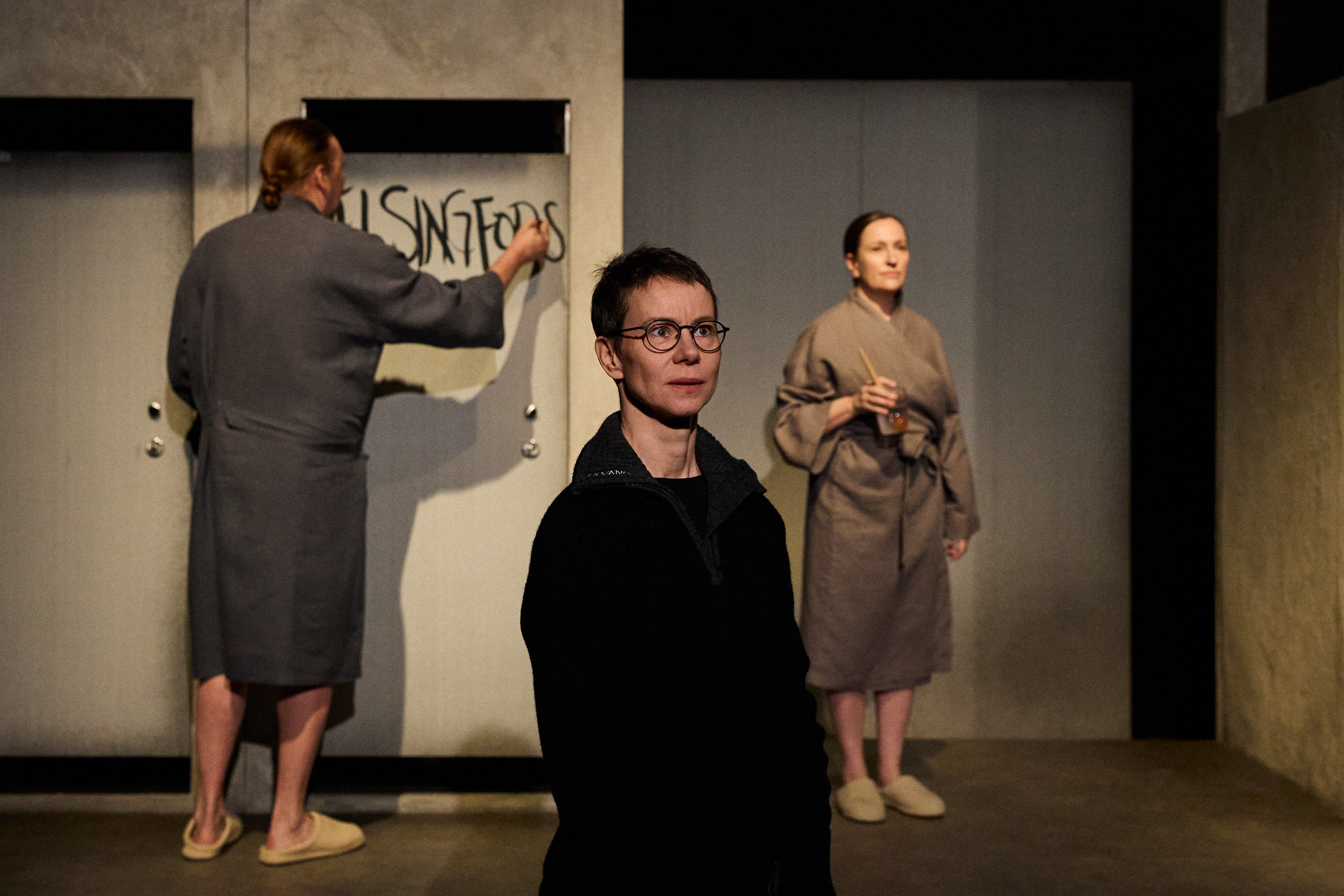
Despite the antagonistic role of the playwright in the interviews, Sarkola is not quite sure of her own standing on the topic.
– I still don’t entirely know how to present my alter ego on the stage,” she said at the time of this article. “It can easily go in the wrong direction. What feels important is to draw attention to the documentary work process, not to the author as a character.
The documentary format may be new for Sarkola, but dialogue has always stood at the heart of her plays and novels. In her second novel, Psykiatrini (“My Psychiatrist”, 2024), conversations had during therapy make up the terrain on which gender relations are played out. The fantasy of a bourgeois heterosexual home life is personified by the older male psychiatrist. The reader is invited to eavesdrop on the doctor’s imaginary relationship with his wife and friends, where what is said presumably reveals more about the patient than about the object of the fantasy.
Gender issues also come up as Sarkola and I argue about the Swedish playwright and theatre director Lars Norén. We are both enthusiastic about his writing, with its luminous dialogue and precision. Outside of the text itself, however, the situation is more ambiguous. For me, a genius male director is an abstract character who does not plague me personally – at least not consciously. Sarkola, in contrast, appears to have enormous stores of rage from which to draw at the merest mention of the cult of a male artist.
I cannot access a similar resource, but it is probably due to having closer ties to literature than theatre. The individual’s singularity is different therein.
– That is probably the case. My anger is a direct result of what I have seen and heard in the field. It is simple to prove that a woman’s pen can be just as sharp as a man’s, but in the collective art form that is theatre, people seem to be drawn to messianic figures. It happens again and again. And ‘strangely’ enough, most theatre managers are male, as are the directors who work for the major stages.
Leadership depends on what one wants to achieve in the space
Ultimately, Sarkola claims, it is a question of what kind of leadership we look for. She stresses the fact that it is not only down to gender, even though issues related to the traditional conceptions of “masculine” versus “feminine” can be discerned in the problem. In that respect she can see a great upheaval happening amid the younger generations. Sarkola herself was brought up to a directorial role whose main objective was to maintain authority: to know and not to ask questions.
– At the end of the day, leadership is a question of what one wants to achieve in the space. What do we expect from a performance? Are we looking for a uniform ecstatic feeling or do we want to achieve something softer, more ambiguous?
Surely there is always something a little creepy about collectiveness? A whole auditorium in hysterics can contain the seeds of a lynch mob. It has a similar quality of volatility.
– Yes. I will probably continue to maintain an unresolved conflict with the collective form that is theatre and its links to mass psychosis phenomena.
—
Milja Sarkola was interviewed by Rakel Similä. The interview was conducted thanks to funding from the Gesellius Foundation.
This article was first published in Swedish on 21 August 2025 at Tinfo.fi.
Svenska Teatern has translated and reproduced it with permission.
Rakel Similä is a critic and culture journalist with a focus on literature and performing arts. She studied literature at Lund University and philosophy at the University of Helsinki.
Milja Sarkola
Milja Sarkola is a bilingual (Finnish/Swedish) theatre director, playwright and author who resides in Helsinki, Finland. She is known for plays including I Would Prefer Not To, Harriet, En familj (“A Family”), All That Is Said and Jotain toista (“Something Else”). Some of her repeated motifs include individuals’ inner conflicts, the power dynamics of family relations, alienation, the boundaries between private and public, and the links between class and art. Her second novel Psykiatrini (Teos, 2024) (“My Psychiatrist”) was nominated for the Runeberg Prize and the Nordic Council Literature Prize. Her first novel was Pääomani (Teos, 2020) (“My Capital”). Sarkola’s latest play, Förgät mig (Forget Me), premiered at Helsinki’s Svenska Teatern on 3 December 2025.